
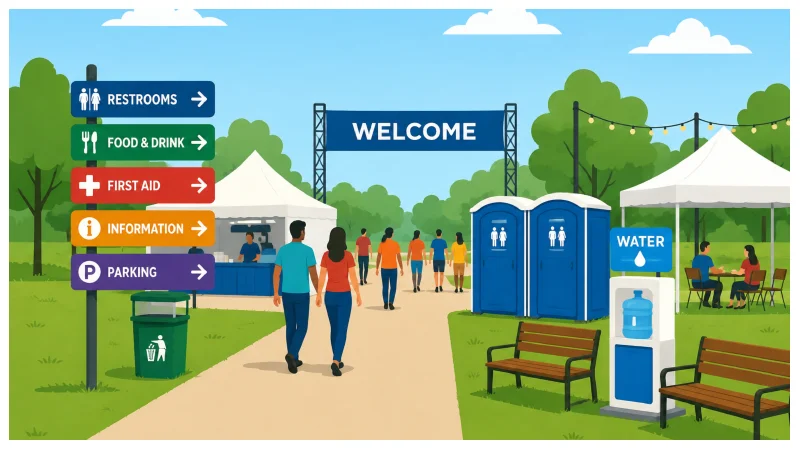
A successful event depends on more than entertainment, décor, and programming. Guests also notice how easy it is to move around the site, find essential services, rest comfortably, and avoid long lines or confusing layouts.
Thoughtful infrastructure supports those experiences quietly in the background. For event planners, the goal is to create a setting where practical needs are handled well enough that guests can focus on the event itself.
Start With the Guest Journey
Site planning should begin by considering how guests will experience the event from arrival to departure. Parking, entry points, ticketing, seating, food service, restrooms, and exits should be logically connected.
Guests should not have to cross service areas or walk excessive distances to reach basic amenities. Clear routes reduce congestion and make the event feel more organized.
Mapping the expected guest journey can reveal problems before temporary structures and equipment are placed.
Make Entrances Easy to Understand
The entrance sets the tone for the rest of the event. Confusing parking directions, long check-in lines, or unclear ticketing procedures can create frustration before guests reach the main activity areas.
Entry points should have sufficient space for lines without obstructing pedestrian or vehicular movement. Signs should identify where guests need to go and what they should have ready.
When multiple entrances are used, planners should make sure each one provides a consistent experience.
Provide Convenient Restroom Access
Restroom placement can affect both comfort and crowd movement. Facilities should be easy to locate without dominating central gathering areas or interfering with food service and entertainment spaces.
Event duration, expected attendance, accessibility needs, and beverage service should all influence planning. Rent Porta Johns is one provider planners may consider, with more information available through their website.
Service access should also be considered so maintenance can occur without disrupting major pedestrian routes.
Create Comfortable Seating Areas
Guests appreciate places to rest, even at events designed primarily around standing or walking. Seating becomes particularly important during longer events, hot weather, or programs that attract families and older adults.
A combination of chairs, benches, picnic tables, and informal seating can support different needs. Some seating should be located near food vendors, restrooms, and activity areas.
Shade should be incorporated where possible, especially during afternoon hours.
Plan for Hydration
Drinking water should be easy to find at outdoor and extended-duration events. Guests may become uncomfortable quickly when water requires a long walk or lengthy wait.
Planners can distribute water stations around the site rather than relying on one central location. These areas should be clearly marked and regularly checked for supplies.
Hydration planning becomes especially important when alcohol is served, temperatures are high, or guests are participating in physical activities.
Keep Walkways Open
Main pedestrian routes should remain wide enough for two-way traffic and accessible to people using wheelchairs, strollers, or mobility devices. Vendor displays, signs, waste containers, and seating should not gradually narrow these paths.
Event staff should monitor high-traffic areas throughout the day. A route that works well during setup may become congested once lines form around food, attractions, or stages.
Keeping circulation predictable makes the entire site easier to navigate.
Coordinate Food and Beverage Areas
Food service can become one of the busiest parts of an event. Planners should provide enough room for lines without allowing them to block walkways or nearby seating.
Trash and recycling stations should be placed near dining areas, and tables should be cleaned throughout the day. Beverage stations may be separated from food lines to reduce congestion.
Vendor access for restocking should also be planned so service vehicles do not move through guest areas unnecessarily.
Include Shade and Weather Protection
Weather has a direct effect on guest comfort. Shade structures, tents, covered pavilions, and natural tree cover can provide relief during hot conditions.
Rain requires a different plan. Covered areas, stable walkways, drainage awareness, and secure temporary structures can reduce disruption when conditions change.
Organizers should also identify how guests will receive weather-related updates if schedules, locations, or activities need to change.
Design for Accessibility
Accessibility should be integrated into the entire site rather than treated as a separate area. Parking, entrances, restrooms, seating, food service, and viewing spaces should all be considered.
Temporary surfaces may require mats or other solutions where grass, gravel, or mud creates difficulty. Routes should remain wide enough for mobility devices and free of unnecessary obstacles.
Clear signage helps guests locate accessible amenities without requiring assistance.
Provide Effective Signage
Guests should not need to repeatedly ask staff where to find basic services. Signs can direct people toward restrooms, exits, parking, food, first aid, information areas, and major attractions.
Placement matters as much as wording. Signs should appear before guests reach decision points rather than after they have already taken the wrong route.
Consistent terminology and symbols make navigation easier across larger sites.
Manage Waste Throughout the Event
Visible litter and overflowing containers can quickly change how guests perceive an event. Waste stations should be positioned near food areas, seating, entrances, and other high-traffic locations.
Staff should empty containers before they become full and collect loose debris throughout the day. Lightweight waste should be secured during windy conditions.
Ongoing cleanup maintains appearance and prevents waste from becoming an operational problem later.
Prepare Staff to Help Guests
Infrastructure works best when staff understand the site. Volunteers and employees should know where essential services are located and how guests can reach them.
Brief staff orientation should cover restrooms, accessibility routes, first aid, lost-and-found procedures, exits, and emergency locations. Staff members should also know whom to contact when an issue falls outside their responsibilities.
Well-informed personnel reinforce the organization created by the site plan.
Thoughtful event infrastructure shapes the guest experience in subtle but important ways. Comfortable seating, clear routes, convenient sanitation, accessible facilities, hydration, signage, and reliable cleanup all help people enjoy the event with fewer distractions.
For event planners, these practical systems deserve the same attention as programming and aesthetics. When essential services are easy to find and the site functions smoothly, guests can spend more time enjoying the gathering and less time dealing with logistical frustrations.