
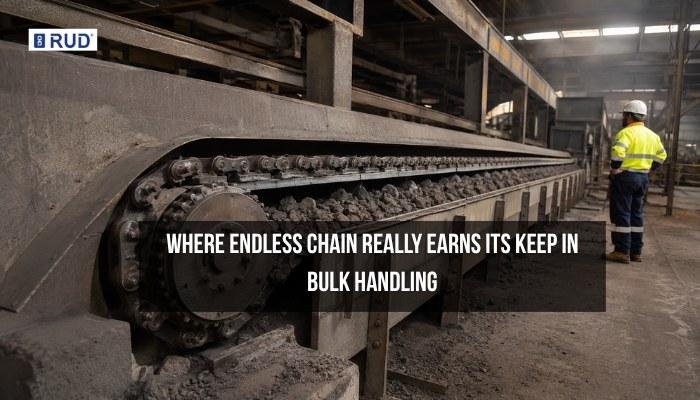
A conveyor chain doesn’t announce when it’s about to fail. One day it’s running. The next, it sits idle, and your bulk handling operation loses production time you can’t recover. That lost time affects schedules, downstream processes, and in some cases, customer commitments.
RUD Australia has spent more than four decades supplying conveyor systems and bulk materials handling equipment to Australian industry. We’ve tracked the same failure pattern back to one root cause: the chain specification didn’t match the operating conditions.
This article covers what an endless chain does under continuous load and what conditions destroy the wrong chain. It also explains how to match your specification to what your operation actually demands.
What an Endless Chain Does Inside a Conveyor System
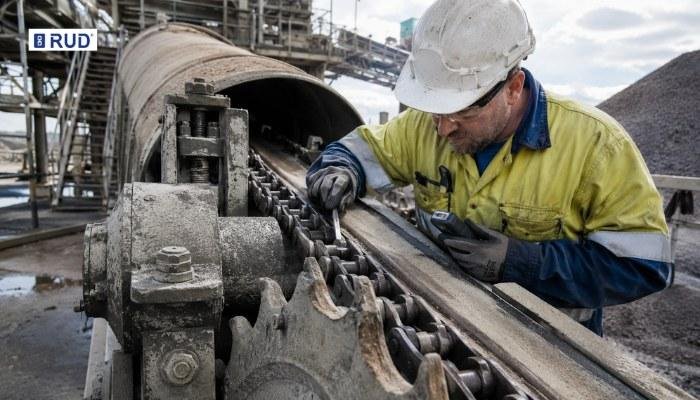
An endless chain is a closed loop with no splice point and no start or end. It runs under continuous load, driven by a motor through a sprocket, and returns along the underside of the trough before repeating the cycle.
How that plays out in practice depends on the system it runs in. Let’s look at the main conveyor types:
Trough and Drag Chain Conveyors
The chain acts as the traction element in these systems. Flights or scrapers attach directly to it, and as the chain moves, those flights push bulk materials through an enclosed trough to the discharge point.
So every tonne of material moving through that trough loads the chain on every pass. In bulk materials handling operations running around the clock, that cumulative load is what separates a correctly specified chain from one that fails ahead of schedule.
Central Chain Bucket Elevators
Vertical handling works on the same closed-loop principle, but the demands are different. A single central chain carries the full bucket load from the boot to the head, typically across 10 to 30 metres of lift height.
What makes this application particularly demanding is pitch consistency. A few millimetres of variation across a worn chain causes buckets to arrive early or late at the discharge sprocket. And that can lead to spillage and casing damage(most operations don’t catch this until the spillage is already visible).
The Three Variables That Govern Performance
Pitch, grade, and surface treatment are the three variables that determine how well your chain performs under load. To start with, pitch controls how the chain engages sprocket teeth. Even minor wear at those contact points affects the entire drive system over time.
From there, grade sets the maximum load the chain carries before fatigue begins. So if you’re running a heavy bulk material and the grade is undersized, your replacement intervals will compress well before the manufacturer’s rated life.
Surface treatment works alongside both of these, determining how long the chain resists the specific material and environment it operates in.
When all three are matched to the application, continuous operation tends to run close to design life. When one is off, the other two rarely cover for it.
The Conditions That Destroy the Wrong Conveyor Chain
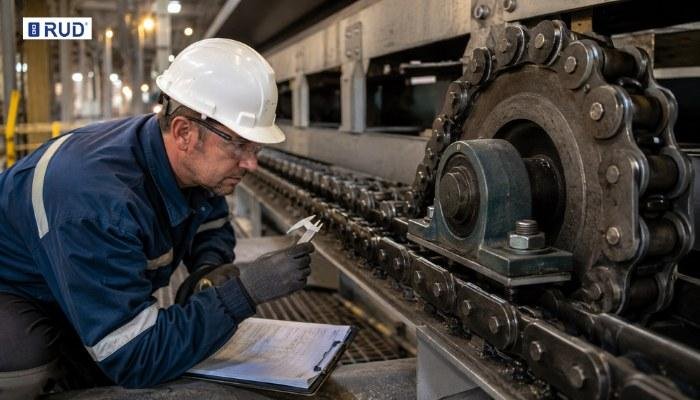
If you’ve taken over an existing conveyor system, its chain specification was likely established years ago under different operating conditions. Materials change, throughput increases, and schedules extend, but the chain spec often stays exactly where it was. And most unplanned outages begin there.
The Institute for Supply Management reported that, based on Siemens’ research, unplanned downtime costs the world’s 500 largest manufacturers USD $1.4 trillion annually. For bulk materials handling operations, a single chain failure during peak production can halt an entire plant for hours.
Here are the five conditions that most commonly destroy the wrong chain:
1. Abrasive Bulk Materials
Coal, limestone, cement, and aggregate grind chain link surfaces from the outside in. The wear builds gradually, but the wrong grade compresses replacement intervals from years down to months without much warning.
2. Moisture and Chemical Exposure
Fertiliser, salt, and potash attack chain pins and side plates from the inside. Corrosion stays hidden until a link fails under load. By the time you see it, the damage is already extensive.
3. High-Impact Feed Loading
Uncontrolled or oversized feed drops at the inlet create shock loads the chain absorbs directly. An undersized chain stretches past its pitch tolerance within months of entering that kind of service, and most operations mistake this for normal wear.
4. Chain Elongation Cascade
Based on our experience, once a chain stretches beyond 2 to 3% of its nominal pitch, sprocket timing breaks down, and trough wear accelerates. Shock loads then transfer into the drive components. What started as a chain problem becomes a drive problem, a trough problem, and an unplanned production halt, all at once.
5. Sprocket Mismatch
Fitting a new chain to worn sprockets, or worn chain to new sprockets, shortens the new component’s service life considerably. It’s one of the most common and most avoidable issues we see across Australian bulk handling sites.
From our experience working across fertiliser, salt, cement, and mineral processing operations in Australia, the pattern is consistent. The operations facing the most frequent chain failures are running the wrong chain for their materials.
Running the wrong chain grade and the right chain past its service life can look identical until you check the specification.
Matching Chain Specification to Your Bulk Handling Operation
Now that you understand what breaks chains under load, the more useful question is how to spec the right one before it becomes a problem. The answer sits across three areas: the application type, the operating schedule, and the components the chain runs with.
Trough and Drag Chain Applications
Material type is the starting point. For abrasive bulk materials like cement or mineral ore, a hardened chain grade reduces surface wear significantly compared to a standard grade running the same application.
Moisture exposure adds another layer. Fertiliser and salt conveyors, for example, need galvanised or stainless surface treatment to resist internal corrosion on pins and side plates.
Operating temperature is worth checking too. Cement and dry ash applications running above 200 degrees Celsius require a different chain metallurgy than a fertiliser conveyor operating at ambient conditions.
And if your operation runs across two or three shifts continuously, that places considerably more fatigue load on the chain than a single-shift operation. In that scenario, investing in a higher-grade chain upfront typically reduces total replacement costs over the conveyor’s life.
Central Chain Bucket Elevator Applications
Bucket elevators place a specific demand on chain that trough conveyors do not. Every link in the loop carries the combined weight of the bucket and the material inside it on every revolution.
So when you specify chain grade for a bucket elevator, account for the fully loaded bucket weight and the material weight alone. Many operations underspec here because they calculate material load only, and the chain pays for it within the first year of service.
Pitch tolerance is the other variable to watch closely. Most manufacturers specify a maximum allowable elongation of 2 to 3% before replacement. Measuring elongation monthly on a bucket elevator chain gives you enough lead time to plan a replacement during scheduled maintenance.
In our experience, operations that wait for audible bucket slapping before checking elongation have already missed the window for a planned replacement.
The Component Matching Principle
Chain performance in continuous operation depends on every component it runs with. What most people miss is that pocket wheels, head sprockets, reversing wheels, and connectors all wear at a rate tied directly to the chain running alongside them.
So when worn component geometry meets a new chain, irregular loading hits every link on every engagement. Over time, that compresses the new chain’s service life by months, and the cycle repeats.
The fix is simple. Specify chain and drive components together as a matched set, and you avoid that cycle entirely.
Australian Standard AS/NZS 4024.3612, which governs chain conveyors in Australia, requires conveyor systems to be designed as integrated assemblies. In practice, that means specifying chain and drive components together, and sourcing them independently creates wear rate mismatches that show up quickly in service.
RUD Australia’s conveyor system components are built around this principle. Central chain, pocket wheels, head sprockets with exchangeable individual teeth, reversing wheels, and Powerblock and Dominator connectors are specified as a matched set.
What to Do Before Your Next Chain Failure Finds You First
Most unplanned chain failures follow the same pattern. The specification was set years ago, the components were sourced separately, and nobody measured elongation until the system stopped. Avoiding that outcome comes down to one thing: the right chain matched to what your operation demands today.
If you haven’t reviewed your chain grade, elongation, and component matching since your operating conditions last changed, that review is overdue. RUD Australia‘s engineering team works with operations across mining, minerals, fertiliser, and waste handling to match chain specification to real application conditions.
Talk to our team about what your bulk handling operation actually demands.